Halloween Costume ideas 2015
Articles by "building"
@dorothiar #arttips #interview 101 2 Column Template 2012 mentee 2013 2013 mentee 2014 2014 mentee 2014 Portfolio Winner 2014 SCBWI Portfolio Mentorship Winner 2015 mentee 3 Column Template 360 3d 3d print 3d printing 3delight 8bit Abbey McCulloch abstract acryla gouache acrylic action addon adobe Adobe Flash CS3 Adobe Illustrator Advanced Tutorials advection Advertising advice Agata Wierzbicka agents airplane Al Wiseman ALA Alan E. Cober Alan Lee Alex Ross Alexandra Compain-Tissier Alexandra Lekias Alexandra Levasseur Alexandre Korobov Alexis Winter algorithm alien ALT Amelie Hegardt Amit Shimoni amusement an Ana Aranda analog Andrea Hrjnak Andrea Hrnjak andrea offermann andreaoffermann andreazuill Andy Musser Angela DiTerlizzi Angelika Peißker animal logic animals animation animation nodes anime anisculpt Anja Kroencke Anna Higgie Anna Jensen Anna McKay Annabel Briens AnneBerry Anneke Krull Annu Kilpeläinen anstudy anthology António Soares ar arduino area armature arrange array array modifier arrow art art director art directors Art is fun! art reps art tools Artaksiniya arthictecture arthur rackham artists artwork ase Ashlyn Anstee Asian aspiring asset atom attribute attribute transfer audio Audrey Kawasaki augmented reality aurasma Aurelius Battaglia author illustrator automatic automation Autumn Whitehurst avatar Avrom Yanovsky AW14/15 award awards Babeth Lafon Babies baboon Baby Love Background background color bacteria bake baking ball Bamboo banner Banner images banner making Barbara Dziadosz barcode basic bbox beads beats Bec Winnel beginner Bel Johnstone Ben Denison Bernie Fuchs Berto Martinez Beth Krush better photos bge Bijou Karman Bike biscuit bishop black and white black and white art Blair Breitenstein blam blender blender game engine blender3d blending Blinkie Blinky blob blocks Blog Tips blogger Blogging Friends blogs Blonde blur effect in pixlr and photoshop blur images and pictures bmesh bmesh viewer bolognaragazziaward bombing bone bone modeling bones book book launch books boomerang bottle bounding box bowl bpy brian eno brian ormiston Brian Sanders brian won brick bridge Bridget Davies bright Brooke Boynton Hughes build modifier building burns business Buttons bvh cage Caitlin Shearer caldecott calibration camera camera settings camera tips Candle capcom card career Carole Wilmet cartoony Cassandra Rhodin cast Catherine Campbell Cecilia Carlstedt cell center pivot centipede cg cg photography chair challenge Chanel changin color in pixlr changing color chaos character Character Bible character development charcoal charles Charlie Dot Charlie Hebdo Children children's book illustration chocolate Christina Drejenstam christina forshay Christina K christinaforshay Christmas Cindy Derby circle circle dance city cityengine clock clones cloning cloth Cloud based clover CMYK Coco Chanel Cody and the Fountain of Happiness coffee collect collection Collections collision color color balance color cast color correction color mode color study colorful Commercial Use complexity component compositing composition computational thinking computer concept art Condensed Posts conference connect connect the dot connection Connie Lim Conrad Roset constrain constrast contagion content Contest contracts control converter copy copyright Corinna Luyken count Courtney Brims crack Craft craftsmanship Craig & Karl creative creativity creature cricket Cristina Garcia Martin critic criticism critique Crop Crop Tool cross section crowd csv cubism curve curve modifier custom Custom Blog Design Custom Blog Design Tutorial Custom Blog Designers Custom Illustration custom properties Custom Signature custom xml cut cutting plane cycle cycles dae Damien Florébert Cuypers Dan Hillier dance Daniel Egnéus Daniel Segrove Danny Roberts Daren Newman Dasha Tolstikova data data path David Blossom david diaz David Shrigley David Stone Martin Dean Hardscrabble Debbie debbie ohi debbieohi deform deformer degrees deleting background in pixler demo demoscene desaturation of images design design by numbers design process Design Tips dictionaries dictionary Different Text Writing in Pixlr digital digital paint Digital Scrapbook Freebies Digital Scrapbooking disk distance distractions distribute diversion DIY DIY Contest Dolf Veenvliet Doll Doll Bones dolls domino domino effect doodle Doodles door doraemon Doris Jackson Dorothia Rohner dots dpi draw drawing drill driven driver drivers dual versions dummy duplicate duplicates duplication dupliframe dvd dynamic dynamic paint dynamic text E Simms Campbell Easy easy pixlr Easy Tutorials Ed Graham Ed Vebell editing editing photos editors education effect effects ego Eleanor Dalton electric Elia Fernández eliza wheeler Elizabeth Mayville elizawheeler Emily Forgot Emma Zanelli emoticon happy-face Emotional storytelling empathetic characters empty entoforms envy epicycloid EPS Illustration Epson scanner erasers Erin Armstrong Erin Petson erinoshea ernest shepard Esra Roise euler evaluate line Eveline Tarunadjaja evenly spacing vertex event everywhere door exhibition Expandable Posts experiments explode exploded view export expression extrude eye eye color in pixlr eye trick eyeball face rig facial expressions facial setup factory Faiyaz Jafri Families fashion illustration fashion week fcurve feature Featured Fee Harding Feedback fence Fernanda Guedes fibonacci Fifi Lapin file File Types Finalists Finding Nemo fire fix photos Flash Tutorials flicker flip flip flop floor flop flow flower Flowers fnmatch focal point follow up font Fontaine Anderson Fonts food footage For Sale force form formula fractal fracture frame Frames Francois Berthoud Frank Bellamy Frank Furlong Franklin McMahon freckles Fred Steffen FrederiqueBertrand Free for Commercial Use Free for Personal Use Free Stock Photography Free transform tool Freebies Frenchillustration Fritz Siebel frosted mylar fruit ninja Fumi Mini Nakamura Fun function futurism FW2017 fx Gabriel Moreno Gabriella Ibarra game game animation gameart gamma gangnam style Garance Doré Gary Fernandéz gel medium generate generative generator geometric geometry Gerald Lazare Géraldine Georges GIF Gildo Medina Girl Giuseppe Castellano Giveaway glorar goals golden ratio google google docs Google Tools Grant Young graph graphite graphite transfer grease pencil grid group group node growth Gucci Guest Guil Godier gustave dore hair handbook Harper's Bazaar harpercollins Harvey Schmidt Haute Couture head Headers heat map Helena Hauss hexagon hexagonal grid Hiroshi Mizuno Hiroshi Tanabe Holiday Holly Black homology honeycomb hook horror houdini how to how to blur a face or an object in pixlr How to change eye color how to delete an object how to desaturate an image how to edit a image in pixlr how to erase an object how to fix red eye problem how to fix red eyes in pixlt How to fix the parts in pixlr in photoshop How to make a banner in pixlr How to overlap the nevus how to remove a object How to remove an object in pixlr how to remove red eyes How to Remove the Background of an Image in Pixlr How to remove the parts that you don't want in pixlr and photoshop how to replace color How to write a Patterned Text in Pixlr how-to Hsiao-Ron Cheng hsv hue humor Hyshil I love illustration magazine idea ideas Igor+André illusion illustrating illustration illustration board Illustration Books Illustration Intensive Illustration Now! Fashion illustration process Illustrations Illustrative Berlin illustrator Illustrator Intensive Illustrator Tutorials iloveillustration magazine image ediditing lessons Image Ready image sequences image theft imaginative import import text import vertex color improving photos inbetween index visualizer Info Ingrid Bockting ink inktober input Inspiration inspirational quotes install instance instance switching intensive interaction Intermediate Tutorials internet interoperability interpolation intersect intersect edges intersecting intersection interview introduction invoke subprogram io ipad Irana Doucer Isabella Hemmersbach islam islamic iteration Izzie Klingels Jack Hearne Jack Tremblay James Dignan James Gurney japanese Jason Brooks Jean Kim Jeanne Detallante Jen and Chris Creed Photography jen betton Jen Rofé Jenny Mörtsell Jeremy Combot Jeslyn Kate Jesse Auersalo Jessica Jessica Lanan jessicalanan jewellery jewelry jiggle Jim Schaeffing Joe Bowler Joe Cleary Joe Isom Joe Krush Johanna Goodman john maeda John Vernon Lord joint Jordan Sondler JPEG JPG jpop juana martinez-neal juanamartinezneal Judge Judit Garcia Talavera Judith van den Hoek Judy Byron Schachner Jules Julien Julian Beever Julie Verhoeven Jump Break Tool JW Anderson K-Fai Steele Kaethe Butcher Kareem Iliya karel zeman Kate van Harreveld Kathrin Kuhn Kathryn Ault Noble Kathryn Noble Katie Kath kdtree Kei Meguro Kelly Beeman Kelly Light Kelly Smith kelly sonnack Kelly Thompson keyframe keyframing kidlit kidlitartists kimberlygee Kirkus Review Kisoo Chai Kodak Konstantin Kakanias Korean illustration Kotaro Chiba Kozue Himi Kremos Ksenia Finogeeva KT Smail kuler Kustaa Saksi Lanan Laptop larry gritz lasso tool latte lattice Laura Callaghan Laura Laine Lauren Rille layer layering Layla Holzer layout leaf learning learning blender LED Leendert meets Ingrid lego length Leonard Starr lessons levels LFW A/W 14 liangzhu liero lightbox lighting lightning Lina Bodén Lina Ekstrand Linda Dorn line line connect line drawing lines Links Linky Love Linn Olofsdotter Lionel Gilbert Lisa Anchin Lisa Billvik Lisa Krannichfeld lisaanchin lisbeth zwerger Liselotte Watkins list list comprehension List First Last listing locator lofting logo Logo Design Lola Dupré London Fashion Week loop looping loops looptools Lorraine Fox lossless lossy lost weekend lostweekend lotte reininger Louis Glanzman louis vuitton Luciana Rondolini luciograph LULU* lv Lynnie Zulu Mac macgyver macouno maeda Magda Antoniuk magic Magnus Voll Mathiassen mailing mailings maker Makiko Sugawa making banners Malika Favre MAMP mandala manga map map range maplelam mapping Marcel George Maren Esdar Margot Macé Margot van Huijkelom Maribeth Olson Marie El-Ahmar Marilyn Conover Marina Esmeraldo Marine Marbleindex mario Marlies Niemeijer Marsha Riti Martha Rago Martin Krusche Martine Johanna mask masking material materials math matrix matrix apply matryoshka Matt Baker matte medium Matthew Woodson maya maze mdd Meagan Morrison measure megaman Megan Hess Meizhen Xu Mel Crawford memory mentee mentees mentors mentorship program Mercer Mayer Meridth McKean Gimbel mesh mesh cutter meshlab Meta Tags metal gear rising Meyoko Mia Overgaard Micca mice Michael Sanderson Michela Picchi middle grade midi miku Milan milipede minidom Minima Mio Matsumoto mirror cut Misc Miss Blackbirdy miss maple's seeds Miss Take Mitchell Hooks mixamo mixing Mobile Apps mocap mod model modeling modifier modular modulation modulus mold molecule molly idle Molly Ruttan Molly Ruttan Illustration money monitors monkey mono-zero monster monster university morph morpher mosaic mosquito motion motion capture motion capture mouse motion trail moto360 mountain muji Muriel Wood Murray Tinkelman mushroom Music and Podcasts My dead pony Nadia Flower Naiad Einsel Naja Conrad-Hansen Natalie Brockett Natalie Foss nathan vegdahl nautilus Nav Bar navigation needle-felting negotiating Neil Boyle neon nescbwi14 nested New Blogger Questions New Blogger Template Tutorials new user pixlr new year new york New York Fashion week Newbery nicholas nicholas bishop Nicholas Hong Niki Pilkington Niso Ramponi nla No Software node node-based nodebox noise non linear animation Non-Web Font normal Noumeda Carbone npr number NURBS NYFW object object color change object info octopus offset Ola Volo Olaf Hayek old formats opaque projector open movie open shading language open source openshadinglanguage opensoundcontrol optical organization origami original art show Ornaments osc Oscar Schlienger osipa osl outline outliner output Pages paint paint weight painting painting on illustration board painting on wood painting with movie painting with numbers Pair pandas panorama Paper paper lantern parabola parametric parent parenting particle particle info node particles pat david Pat Zietlow Miller pattern Patterned Text Paul Faassen Paul X. Johnson Paula Sanz Caballero PC pdb pebbles pencil Pencil Sketch pencils Penguin perfume perlin Peter Helck Photo CD.8B photo editing software Photo Reference Photobucket photographing art Photographs photography photomerge photoshop Photoshop Brushes Photoshop CS3 Photoshop elements photoshop pixlr desaturaion Photoshop tips Photoshop Tutorials Picture Book Builders picture books Pierre Louis Mascia Piet Paris Pietari Posti pingpong pinnochio pipes pixar pixel pixel art pixel generator pixlr Pixlr advanced Pixlr blog pixlr desaturate keep a colorful part pixlr editting pixlr express Pixlr forum Pixlr free transform Pixlr Lesson Pixlr lessons Pixlr mobile Pixlr resizing images pixlr shortcuts Pixlr tools pixlr tutorial pixlr tutorial with pictures Pixlr Tutorials pixlr white black pixlr.com plant plot plotting ply PNG PNG Illustration podcast point point color pointilism polka dots polyCut polygon Pomme Chan pop-overs portfolio Portfolio award portfolio showcase portfolio-advice portrait position Post Dividers postcard poster Posting pot powdered graphite powerhousemuseum Prada presentation print printmaking Prize procedular procedural process processing programming projection Promotion property prototype PSD psy publishing pulse puppet puppetry pydriver pydrivers pyhandler pyhandlers pyramide python quad quick select set quick tips qumarion Rabbit Moon Rachel Ryle radians radius ramp random random motion randomization randomize range float raspi Ray Houlihan reading reading XML READY-TO-WEAR realflow Rebecca Clarke rebecca dautremer Rebecka Skog rebuild recursive recursivedrawing red eye remove reducing glare reference referencing release remesh modifier remix removal remove remove red eyes remove unwanted objects Removing backgroung render rendering renderman repeat repeater repeating replace replacement replacing color representation rerouter resample resampling research Resizing image resolutions retopology retro review revolve rgb rib Ricardo Fumanal Richard Scarry rig rigging rigify Rikke Jorgensen ring ripple roadkill Robert Heindel Robert J. Lee Robert McCloskey Robert Shore Roberta Zeta Robin Rosenthal robot robotic rocks Rodolfo Montalvo Roller Coaster rotation Rousseau rsl Rubin Pfeffer ruler tool Russ Mills russian rut S/S14 S/S15 S/S16 Sabine Pieper sadako Saftey Pins Sainte Maria Sale Sam Weber Sanda Suy Sandy Kossin santoso Sara Andreasson Sara Singh Sarah Jacoby saturation artist tools scan scanners scanning scatter scbwi SCBWI 2015 mentee SCBWI conference scbwi germany SCBWI mentorship scbwi-la scratch scratchboards screensaver screw screw modifier script scrub sculpting seamless Seamless Patterns Search Engines select by material select by name select by type SEO sequence series set keyframe set keyframes shader shading shadow Shannon Stirnweis shape grammars shape key shapekeys shapes shards shatter Sheilah Beckett shell ship shipping shipwright Shoes SHOWstudio shuffle Sid Barron Sidebar Titles Signature Silja Goetz silkworm Simon and Schuster Simon Varela simple simplicity simulation sine Site Engine Optimization Sjoukje Bierma sketch Sketches sketching skin skin modifier skinning slice slicing slides sloth slow parent smoke smoothstep SN snake Sneek Peek snippet Snow Snow White Snowflakes soccerball social media Social Media Buttons Social Networking society of illustrators Society6 soft body softbody Sonia Menti sound sound wave space spaceship sparta special spider spiderman spiderweb spin spiral Spiros Halaris Spiros Halaris x Urban Decay spline Spot Healing Tool spreadsheet SS16 stack stacking stair stamp Stan Galli star starfish stencyl step Steven G. Dobson still Stina Persson stone stones storytelling strand strand info strands street art string stripes structure studies studio style stylistic summary Summary Posts Summer sun supplies surface Susan Farrington suzanne Suzanne Kaufman sverchok swatch switch sydney system table table of contents take out background Tal Drori tangent tangled Taschen teaching teapot Template Templates tentacle Tess Jacobson Tex Avery text text editor Text Formats Text Styles in Pixlr texture texturing The Cartorialist The Grudge Keeper The Purple Book thinker1 Thomas B. Sawyer thread TIFF tile tilecam tiling time time code Tina Berning Tina Kugler tips tips for artists Toby Neilan Tom Baxter Tom Bjarnason tombow tomie depaola tool tools topology tower Tracy Turnbull Train transfer drawing transferring sketch transform transformation transit travel triangle wave Tricia Springstubb trigger tris tristan lock tube tubes Tutorials twitter type tool typeface typography unbake unity3d universal unquad utah uv valentine Valentino Valerie Servais vanilla variable variation variety vase vector vectorized Velwyn Yossy venus Veronica Ballart Lilja vertex vertex color vertex group vertex paint vertex weight VFX Victoria Boysen video Videos viewer Vintage virtual virtual studio visualization vivid vividfestival VOGUE volumetric voronoi Vote voxel voxelated voxelation walking teapot Walter Einsel wand tool water soluble graphite watercolor wav wave we need diverse books web webbing Week Themes weight welcome Wendy magazine Wendy Plovmand what casues red eyes What is Pixlr Wherever You Go Wide Awake Bear wiggle Will Davies Winner Winnie Fitch Winnie Truong Winter wire wired wireframe wolfram Woman wood woodwork wool wooly wordpress work workflow World writing writing XML www.pixlr.com XML YA yayoi kusama Yelena Bryksenkova yoda Yoko Furusho Yuliya zaha hadid zen zsphere

Suzanne possesed by Eval Knievel of Sverchok.

Here we go again, more basics yet useful Sverchok snippets to brighten your day. Plenty of them!

The more one explores Sverchok, the more one discovers interestingness of Sverchok Add-On and Python, and as well many other related areas that also reveal Blender capability and also procedural, parametric, computational concepts.

We can think of Sverchok as a new language inside Blender for modeling, animation and other things.

Advance Grasshopper Plugin
For example, this video was pointed by Zeffii the other day, it is a video lecture on Grasshopper plugin for Rhino video, displaying a node called "Galapagos" explaining "Genetic Algorithms":
https://www.youtube.com/watch?v=4QqkxT1XeNw

That kind of setup is really impressive. A kind of thing that I would like to see in Blender. The setup might get complex, but first the thinking and understanding of the concepts is truly invaluable.

Sometimes it is not how complex or complicated of setup you can build, but how deep one's understanding of small things that allow him/her to continue to advance.

And of course, you cannot do it alone. In fact, this kind of computational thinking is pretty collaborative. You think, it is just you and the computer, but in fact, it is many brains and the computer. I owe a lot from the helps of Sverchok Developers, with their examples in code and node.

RE: Sverchok Setup

Installation of Sverchok should be much simpler now and should NOT give you any error message. Many asked me same questions, so I will re-write it again.

Download the latest zip from Github. Click on "Download Zip" button.
https://github.com/nortikin/sverchok

After Sverchok installed, inside Node-Tree panel, on the right side, you should get this panel that allows you to check if there is a new version to download.

Now, from my experience, sometimes this works, sometimes does not. When it works, you feel awesome. Sometimes it says "cannot extract". In such case, I would just reinstall Sverchok Add-On by removing and adding the latest Zip. No sweat.


Nikita made new tutorial and provide some more serious examples.
http://nikitron.cc.ua/Sverchok_man_09.html

What's new in Sverchok? By the time I am writing this, there are already some more new things. Whether improvement in speed, some more Formula Math, or some more nodes. So let's look at some things.

SVERCHOK 3D VIEW PROP NODE

A simple node that gives you quick access to tweak 3D View while working inside the node-tree. This node allows you to:
- View Render Only
- Show/Hide Grid in X,Y,Z
- Change grid color
- Gradient Color Option
- Switch Blender orbit navigation between Turntable or Trackball


FUNCTION WAVE RELOADED


  • Range Min Max
  • Some Math Nodes


How many times have I touched on SINE WAVE? Probably too many times already, but Sine is simple and it explains many concept.

I will touch on TRIANGLE WAVE today. Triangle wave is not as simple to create, we need a specialty function to get this wave. With Sine wave, we just plug it in into Math Formula node.


Above will give a static Sine wave. If you want a movement, you just "push" the wave in time, just by adding offset values, normally the input is Frame number.

This Triangle wave also create pattern that looks like a Zig Zag, or Ping Pong pattern that can be useful for animation when we want it to go back and forth repeatedly but in a linear fashion (no acceleration or change in speed). While Sine wave does this smooth pattern that goes between -1 and 1, Triangle wave is linear, straight line goes from -1 to 1 repeatedly in a constant speed.

Some useful links I found when researching about triangle wave:
http://en.m.wikipedia.org/wiki/Triangle_wave
http://stackoverflow.com/questions/1073606/is-there-a-one-line-function-that-generates-a-triangle-wave

That one link from Stack Overflow gives the formula I needed, something like this:

min = 0
max = any maximum number (this is the Amplitude)
i = number of iteration (a growing number)

Assuming min is 0 and number grows:
x = max - abs ( i % (2 * max) - max )

Let's translate the formula above into Node Tree. You can use Formula2 node, however, this time, I want everything to be nodes and noodles.

Start from the deepest nest, which is ( 2 * max ). Then continue on and see the correlation of the function, break and convert each part into node tree.


A better setup would be to use Range Float node instead of relying on Line node. Range float allows you to have more control over the "length" of the wave while adjusting the resolution details of the wave. It seems like a small feat, but important.


Triangle Wave = Ping Pong animation
Do you remember how we can use MODULO function to get a Looping kind of animation? With Triangle wave, we actually get a Ping Pong kind of animation.

The setup below will show you clearly what is really happening. Supposed I draw a stroke using Grease Pencil like below. And I want a sphere to travel from the start point on the left to end point on the right. Below is one way we would set it up.

We first set the trajectory of Sphere along the Grease Pencil curve. How much details of interpolation we want it. Then using List Item, we specify exactly where and when the Sphere should be placed.
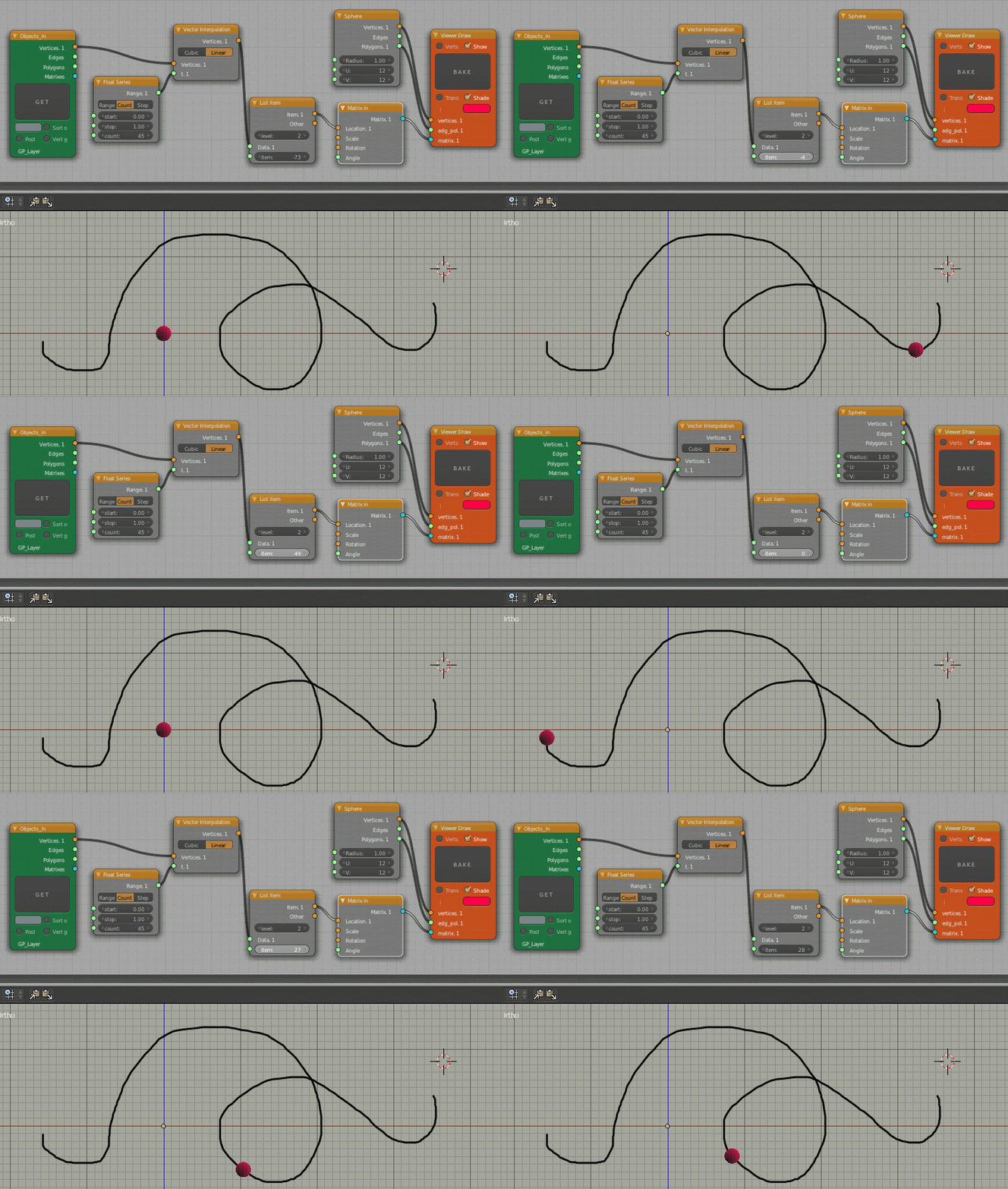

Above, I am manually sliding the sphere along curve. Using function, such as Linear Curve, Sine wave curve, or Triangle Wave, we will be able to control the motion.


There is a bit more to explore here, but I leave it there. Just to get the basic idea.

I think it can be further simplified. With our setup, we end up with triangle that does not really go between -1 and 1. I prefer it to go between that range that we can remap.

NOTE: Technical note, usually with a setup that requires us to resample the curve (Grease Pencil), Vector Interpolation needs to do the hard work to process Grease Pencil curve. Even such a simple curve above is nearly 4000 points. Thus, you get a slow frame rate during animation. This is not so much of issue since we can always bake or cache the mesh output. However, I suggest that you ALWAYS Simplify the Grease Pencil or reduce the counts before you brought it into Sverchok. Did you know that originally "animation" was not planned in Sverchok? There you go, we are lucky to have animation happening!

Random Spawning inside Box Volume

I have some interest with Unreal Engine 4 recently. And this video is kind of interesting:
http://youtu.be/9-7SmkasS_A

In relation to Sverchok, from the video above, we learn to be spawn points inside Box Volume.


Inside Sverchok, we cannot really "scatter" points into surface or volume. However, we know that Blender Particles has that capability right? And we can use that for now. Below is Particle Volume and KDtree Edges node working hard making all those edges.


Vector Interpolation can also be used to kind of randomly scatter points, in between points.


In a simpler scenario below, it is more clear.

Between 2 Points in 3D space, scatter some random points of specific count.


For every point between 2 points, plant some Lines. We get something that looks like a barcode.


Do you know that in recent Sverchok, we have the ability to use Vectorized Input for Lines? Which means you can now have array of lines with different number of vertices?


This means array of lines, where each lines has different stack is possible. That would make layout for city building a lot easier now, right?

Procedural Fence and Bridge should be easier to create this way, created under 30 nodes.


I tend to think in term of Lines, which could be useful too. That way, we have the Outlines and kind of have the relationship of each parts.

Then what we do is simply replacing each dummy Lines with the real part. Each part can also be made procedurally. Or it does not need to. You simply have premade Modular Part that you have modeled.

Thus we create a modular and reuseable system.

Building Complexity with Modular Parts

When I just started, I always think of building everything at once. While it is possible, but also not efficient.

Just like writing a novel, we should probably start by creating the Outline or the Cage, then we started to build on that.

So for something we build procedurally and parametrically, we should also think that way. We can prototype using dummy object. See how we can break parts.

1. TOWER BUILDING: Roof Top Part, Bottom Facade Part, and in between parts.
2. SNAKE: Head part, Body Segments, Tail part
3. BIPED CHARACTER: Head, Body, Arms, Legs
4. INSECT CHARACTER: Antenna, Head, Body, Legs, Wings

I made this Procedural Centipede the other day at the Library. This is not that different from Procedural Dominos, except that here, we have segmented part that makes the body of Centipede. And with centipede, each part have Left and Right leg. Sometimes, each segment have 4 legs. Each part should be replaceable.

Maybe the segment have some details, and perhaps closer to the head and tail, the segment is getting smaller. And maybe the Head and Tail part needs to be replaced with a more detailed version. That is all should be carefully thought before we start creating this.

Perhaps the Spine will change and can be animated. Should we just start with a straight spine? Perhaps each of the spine will become Blender Armature Bone to drive hundreds of Centipede.

Yes, that is also something to be considered beforehand. This is when your brain start to think procedurally or even more parametrically.

While some well done node-based setup allow users to create complex things almost without thinking (which can be pretty embarrassing) however, in most real case scenario, good artists must learn to understand the concept. Not always having to re-invent the wheel, but be creative with solutions.

Below is a good quote from "Think Python" online book.


Procedural Centipede WIP


You might notice that I am using some new Curve Generator node in Sverchok, they are:
  • Basic 3 Pt Arc
  • Basic Spline

MEET EVAL KNIEVEL NODE

To close our Snippet article today, I will show you the new Eval Knievel node by Zeffii.

Documentation:
https://gist.github.com/zeffii/527bd6537357629e173f

This node is like a simpler version of Scripted Node, basically a single liner node to insert Python magic that allow you to possess some parts of Blender outside of Sverchok Node-Tree.

It can read/listen INPUT from OUTSIDE SOURCE and send OUTPUT to OUTSIDE SOURCE. This node is pretty eval, I supposed!

SET VALUE
= {x}

GET VALUE
{x} =

The code is running backward:

Example:
print({x}[0]); blah = {x};


To possess Cycles Material using Eval Knievel

import colorsys; data.materials['Material'].node_tree.nodes['Emission'].inputs['Color'].default_value = colorsys.hsv_to_rgb (*{x}[:3]) + ({x}[3],)

import colorsys; data.materials['Material'].node_tree.nodes['Emission'].inputs['Color'].default_value = colorsys.hsv_to_rgb ({x}[0], {x}[1], {x}[2]) + ({x}[3],)

Above line of code takes INPUT X and pass it to Cycles Material Color, in HSV wheel.


Suzanne Possessing the Sverchok Ghost by Eval Knievel
Suzanne Transform Matrix => Drive Matrix of Sverchok Object


3D Cursor being possesed by Eval Knievel
Random Position value => drive 3D Cursor


Eval Knieval works only for a single object, not for array of objects. It is definitely possible to make it works with many objects.

If I am not wrong, the node will evolve and enable you to call Python Function from Text Editor. So, in the way it is like quick Drivers and Python Expression.

So for this Eval Knievel node, you need to know a bit more about Python and Blender Python. Use it wisely and carefully.


http://lucumr.pocoo.org/2011/2/1/exec-in-python/
http://nedbatchelder.com/blog/201206/eval_really_is_dangerous.html
http://effbot.org/zone/librarybook-core-eval.htm


Prototype Procedural City Generator.

I was looking at ESRI CityEngine the other day. Someone mentioned about it at the Sverchok thread on Blender Artist Forum. CityEngine is quite impressive. I like how simple it looks to work with such a complex thing like city and building generations. It also has its own programming language, set of RULES they called it to generate city. READ: "CGA shape grammar"

ESRI CityEngine is quite impressive.

There are many tools out there that can procedurally generate city these days, which is quite amazing. I have not had chance to try on any of them. I am sure they are all good and we can study them and try to apply the concept in Sverchok.

In the past I remember using few scripts for Maya does procedural city (buildings) creations. The one I like the most is "QTown for Maya" from Brave Rabbit.
https://vimeo.com/28773741

QTown by Brave Rabbit. Simple and easy to use!
If you read my past blog post, I have mentioned on how I always wanted to create "Procedural City".

It is a WIP and Research in progress. It is one of my dream to be able to create inside Blender. I also want to make "Procedural Creature" that is next in plan. Sverchok makes some things easier, especially in procedurally editing mesh.

My principle is always not so much on just giving tool, I always want to understand HOW TO create the tool and hopefully I can share the knowledge.

None of these are new, I just want to explore it in Blender using Sverchok Add-On. Sometimes I like to re-invent the wheel to understand how it is made.

Worth to look is this Suicidator City Generator, probably the most solid Add-On for Blender for building city. I have mentioned it few times in the past:
http://cgchan.com/suicidator/

PROCEDURAL CITY: Random vs Real

So the task is to create a CITY, random/specifically made skycrappers tall buildings by the means of NODING or CODING.

  • NODING = using nodes and noodles
  • CODING = using code and programming

I like NODING because the result can be more interactive, that's because NODING always has interface and parameters. Or at least it feels simpler because we care about INPUT and OUTPUT and we know that the node will hopefully do.

NODING is "visual" and actually can be recreated more easily even if you don't have programming knowledge. However, that is also often the MISLEADING PART.

Many software like Maya and Houdini claimed that PROCEDURAL and NODE BASED is "easy" and can allow advance effects without programming. It is not fully true.

Procedural or parametric is a hidden complexity. It will take some LOGIC and it is not necessarily easy. But it can be learned and explained, just like cooking. You may not get it at first. You will be stucked a lot. You will get error a lot and Blender may crash a lot (in case of Sverchok). However you are ALLOWED to make mistake and experiment and see the result. Find a problem and fix it.

Stick with this stuff and actually give effort to understand it and you will be rewarded.

(enough preaching, let's continue....)

When it comes to "iteration", CODING could be simpler to implement. A once off code that can run multiple time on many objects. CODING can also be faster and efficient, compared to connecting noodle and nodes. Nodes always need to calculate and bake and update the result. This can be slow after sometimes. Which means we are no longer can see realtime update via parameter. In such case, CODING is totally way to go.

Either way, I respect both way. We probably need both means to tackle task like "Procedural City".

If we need to generate city that actually existed in our world, then we can look at something like OpenStreetMap. Add-On like OSM importer below for Blender is useful.
http://blenderartists.org/forum/showthread.php?334508-Addon-Import-OpenStreetMap-(-osm)

My wishlist for that above is to also import the building height for extrusion. Then each building can be detailed according to one's needs. It will be an interesting task to think about.

When it comes to "random" or "generative", we basically need to think about RULES that we need to apply for each task, such as:
1. Road and Street Map, including their intersection
2. How buildings will be laid out within the space created by Road and Street
3. How buildings got stacked and detailed: how tall, roof part, bottom part, windows part, etc.

THE PLAN

I first draw a plan and see how this can be implemented using tools and functions inside Blender. Obviously this is a big task and I have to allocate time and allow improvements.


I am not attempting to do everything in one writing. I will do try to solve by breaking parts. I don't have architecture background, I actually need to go and read some architecture books, which I think important to understand elements of buildings.

ELEMENTS Street and Road Map

We will have some kind of AREA of TERRAIN. It is not flat, but to build building we probably need to FLATTEN those area.


However, we could explore the idea or PROCEDURAL STREET/ROAD a little bit.

What is the first thing came up in your mind to draw street? Grease Pencil? You bet! That's also the first thing in my mind.

We could draw some street and road from TOP VIEW and PROJECT it down.


There will be some INTERSECTING Lines that we need to deal with. Maybe using Sverchok.

There is some convenient of using Grease Pencil. It can be converted into Polygon and Curve object in Blender and both can be quite convenient or inconvenient, however we look at it.

Grease Pencil => Curve => Street

Remember that converting Grease to Curve is always resulting in very dense curve, and we need to always Simplify Curve first. Clean curve is better.

Turn off "Link Stroke" option when converting.


Use "Simplify Curve" add on. --- hopefully when Blender NURBS got improved after Google Summer of Code 2014, we can have CURVE RESAMPLE.

AFTER SIMPLIFY CURVE:

Curve in Blender is SPECIAL. Just like Text Object and Armature Object. It has A LOT hidden feature in it. Curve has many build in "procedurality", such as EXTRUDE and BEVEL.

For what we are doing, we keep it simple, I just show you that we can switch between 2D and 3D. With 3D Curve, we can TILT the curve and that will affect the extrusions.


We just need to PROJECT it down the ground. Would be nice if the TILT was also affected by the angle of how it got projected down into the ground. And it sort of does! We just apply Shrinkwrap modifier to the curve and adjust the parameter.


That is the basic idea. One day we cover how to create RAILWAY or ways to detail streets and roads with lamps and so on.

Grease Pencil => Curve => Polygon Edges

What if we actually use Polygon for this task? With polygon, the advantage is to be able to have Intersecting Points in between lines. That can be taken care using Sverchok "Intersect Edges" node. Not always the fastest but it will do the job.

Watch out with dense Mesh. When you are converting Grease to Curve to Poly, make sure that your Curve is Poly and it has decent numbers of Points.

Dense Edge Mesh will calculate too long time and will definitely crash Blender. See below how many points and curve I have, not many.

PYTHON METHOD:
http://blenderscripting.blogspot.com.au/2013/05/developing-script-from-start-to-finish.html


SVERCOK METHOD:


Bake the resulting EDGES that now have Intersecting Points. By doing that you can Skin Modifier it and you can have a nice connecting intersecting lines! This should be useful to create Pipes or Tubes too.

You can further clean up the Edges using REMOVE DOUBLES in Blender or inside Sverchok.

NODE: Intersect Edges

There is a "QUIRKINESS" of Intersect Edges that actually carries the original Edge DATA with it, which probably not what you want.

CORRECTION: This quirkiness is intentional, to allow us to do more things, such as exploding the intersection lines. We can use Remove Doubles if we do not want the edge or point doubles.

I advice you try to create a setup like below with 6 x EMPTIES and all the criss-crossing lines and see how Intersecing Lines really work.


You can use Blender REMOVE DOUBLES or Sverchok REMOVE DOUBLES node.


Basically it is possible to have a CLEAN INTERSECTING LINES.

If you use FILL HOLE, it is possible to have nicely filled PLATE.


And you can use Wireframe Deformer (because it needs faces).


All those above are useful techniques to consider when creating Street and Road.

ELEMENT: Buildings around Shape

Next, we have tasked to FILL the area created by those INTERSECTING STREET and ROAD.

After some experiments, I think the simplest area to fill is when we have CONVEX Profile. It's area that does not have curve profile that goes in.


Actually Convex or Concave will not matter so much, depends how we like to create the building around the area. I was thinking something like below:


1. We basically draw an INSET from the SHAPE.
2. Then from inset, we already have QUAD FACES, and the rest is easy and straight forward.

There are of course many other ways we could approach. There is this "dividing square randomly" algorithm that I quite like that I have seen before.

Something like below:


Above the CITY ENGINE also does this Square Cutting of any area. It is cutting with lines but with slight offset. I have to research on this next.

Those SQUARE LIKE City arrangement is another example CITY ALGORITHM we could use. City of Adelaide is a bit squarish. New York City is also a good study.

I actually quite like these "SQUARE PACKING" algorithm.

For now, let's just do it by creating PUBLIC HOUSING type of building blocks. Simple one first.

START WITH A CONVEX SHAPE

I will be using one of the Shape Plate we have created above by cutting lines. Flat plane.


Now, let's jump into Sverchok and start creating and dealing with GHOST MESH.


First of all, what we need to do is to create INSET type of MESH. We don't have Sverchok Inset Node (yet), so we need to recreate it ourselves.

Blender has Inset function, but we will not use it. We want this as procedural as possible.

Let's create INSET operation. We are basically pushing or pulling the original Vertices using the Vector of each points. So I will do exactly that.


There is probably limitation of this method, but should be ok for now. Concept wise. If we are using Blender 2D Curve, it has OFFSET option that might be handy.

However, we are dealing with Polygon only in Sverchok. Let's live with that for now.

Now to fill the AREA between original SHAPE and offset SHAPE, we can use Cylinder Topology. Here is the preview:


And this is the actual thing.


We just need to specify the right number of Vertices for the Cylinder generator node to give the right topology. There is only 1 correct value => which is the total number of Vertices that the SHAPE have. Sometimes if you go OVER, Sverchok might crash Blender. Use LIST LENGTH node to ensure we got the correct total points.

Now, we have QUADS to work with.  We can create our Building Blocks using the uber useful ADAPTIVE POLYGONS node.

ADAPTIVE POLYGONS node is a type of COMPOUND node. We could actually build it ourselves and may have a bit more control. However for now, this is fine.

Prepare DONOR object, we just use CUBE for now. Sverchok BOX node can do this. But you also need to "place the box on the floor".

What we get now:


You may notice that I made changes on the LIST JOIN node. The correct setting is as below:


Below is the cleaned up version. I also placed the BOX ON THE GROUND.


We have our PUBLIC HOUSING building blocks. However, they are a little bit too boring, we can probably randomize the height a bit.


This is how far I actually have gone with this Procedural City.


We could definitely use the VECTORIZED INPUT, so that we can bring in MULTIPLE AREA PLATES to generate building.

Our building is just an ugly simple block at the moment. Detailing and modifying building, probably best done using CODING. Script Node of some sort, that way we can give variations according to our need.

There are often interesting issues you need to deal with:
  • Vertice Sorting (yes, some of those vertices might be out of order!)
  • Flipping Face Normal (building grow into the ground).
All normal and part of procedurality! No Rules cannot be broken by Numbers!


It's a prototype.


Soon enough, I realized that we need to deal with:
- UV and Procedural Textures (OSL maybe?)
- DETAILS: Trees, Street

I guess I need to do some research, probably next gen Games is a good start. Spiderman game and all sort of games that have procedural city.

Above is not the only solution, but just pieces of ideas that you may or may not use. Basically I think with CITY, we need some kind of ways to generate the TOPOLOGY Map first. Kind of way to automate and separate AREAS and still have control. What I did above is very basic, it is just random extrusion from original maps. However, I think it can be further developed and refined.

Next thing I should study is actually the QTown script for Maya. It can be ported to Blender, actually.

FURTHER ON: Voronoi

Voronoi 2D can be used to create random yet natural mapping.


Remember the Spiderman "I LOVE YOU" writing on The Amazing Spiderman 2, which can easily be created using Voronoi. We can use it to draw random Map.

OK, now I realized that in order to populate MANY AREA PLATES such above, I really need to tweak my setup above so that it works for Multiple Objects (remember the VECTORIZED INPUTS).

Either, we need to "separate every mesh" part or allows for multiple mesh. I think it needs to work with both scenarios.

Once that's taken care off, it's just a matter of bringing in ANY MESH and it will populate it with simple buildings. Simple building for now, the reason being = remember Sverchok is dealing with Mesh, not actually Instances, unlike Particles, every Mesh is REAL.

SCATTER RANDOM SHAPES x INTERSECTION


LINKS AND READINGS

http://cs.brown.edu/research/pubs/theses/ugrad/2013/zweig.pdf
http://www.cg.tuwien.ac.at/research/publications/2010/dusberger-2010-msm/dusberger-2010-msm-report.pdf
http://www.ia.arch.ethz.ch/wp-content/uploads/2011/09/HS11_CityEngine_overview.pdf
http://homes.esat.kuleuven.be/~mmathias/publications/3dimpvt2011.pdf


MKRdezign

Contact Form

Name

Email *

Message *

Powered by Blogger.
Javascript DisablePlease Enable Javascript To See All Widget